


Thank you for Subscribing to Med Tech Business Review Weekly Brief

Elekta [STO: EKTA-B]
Leo Hovestadt, Director Governmental Affairs EU
Artificial Intelligence Regulations and Its Impact on Medical Devices

Leo Hovestadt
Leo Hovestadt is involved with developing and implementing medical device regulations and guidance, starting with the Active Implantable Medical Device Directive 30 years ago. Leo is the author of the recent MDR Guide for Medical Device Software, and is a regular key note speaker on topics like medical device clinical evidence, artificial intelligence and digital health. He is the Director EU Governmental Affairs of Elekta, a radiation therapy medical device company.
Introduction Artificial intelligence (AI) has huge potential improving healthcare using the vast amounts of clinical data. AI software algorithms can use real-world data to support better health care decisions or improve performance and safety of medical devices. Manufacturers have embedded AI technology into various applications such as imaging, laboratory testing, patient monitoring, personalised apps and robotics. AI also presents unique challenges due to its complexity and the iterative and data-driven nature of its development. This triggered the development of the European Union AI Act and the development in the US, Canada and the UK of the Good Machine Learning Practices. European Union AI Act The European Union AI Act (EU-AIA) is aimed at covering AI in general. The structure of the Medical Device Regulation (MDR) was used as blue print for the EU-AIA. This is very pleasant, since it makes the EU-AIA easy to understand. The MDR includes requirements on risk management, conformity assessment by notified bodies, post-market surveillance and a vigilance system. Those elements can also be found in the EU-AIA.The goal of good machine learning practices is to promote safe, effective, and high quality medical devices that use artificial intelligence and machine learning
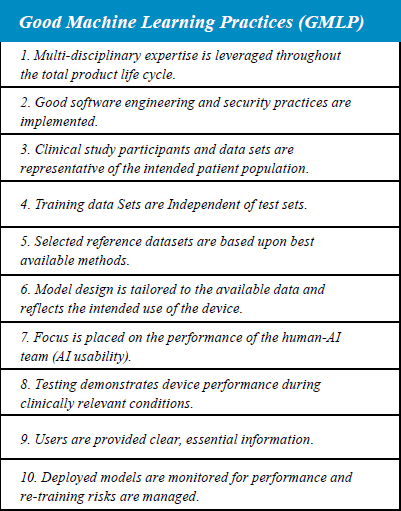 Good Machine Learning Practices
The FDA, Health Canada, and the UK MHRA have published Good Machine Learning Practices (GMLP) that can be used to develop AI medical devices. The goal of Good Machine Learning Practices is to promote safe, effective, and high-quality medical devices that use artificial intelligence and machine learning. The 10 practices identify areas where the International Medical Device Regulators Forum (IMDRF) and international standards organizations could work to advance GMLP. The guiding practices can also be used to develop MDCG guidance for the EU-MDR, instead of using the EU-AIA.
The guiding practices are shown in the table. Each guiding practice has explanation in the related publication on how to apply it. Guiding practices 1, 2, 5, 6, 9 are straightforward, logical and good implementable advise. Guiding practice 3 makes sense, however might be in conflict with the EU-AIA. Guiding practice 4 seems logical, but might need adoption for rare diseases where only small data sets are available. Guiding practice 7, 8 and 10 deserve special attention form manufacturers and users, since they cause regular issues in practice.
The MDR uses additional concepts to the GMLP such as benefits need to outweigh the risks, the medical device needs to be state of the art, and clinical evidence need to be available. However these concepts are already part of the MDR requirements.
Conclusion
The EU-AIA makes it difficult or impossible for good AI-based medical devices to be placed on the EU market. The EU-AIA should be fully consistent with the MDR. This is most easily achieved, by not including the MDR in EU-AIA annex II section A, but by including the requirements of the EU-AIA in MDR MDCG guidance.
Recently the USA has become the preferred location to place AI-based medical devices on the market, because of the complexities of the MDR. The additional complexity introduced by the EU-AIA will accelerate this development. There will be less choice and delayed access to crucial digital health innovation for European patients and healthcare professionals, which cannot be the purpose of the EU-AIA.
Good Machine Learning Practices
The FDA, Health Canada, and the UK MHRA have published Good Machine Learning Practices (GMLP) that can be used to develop AI medical devices. The goal of Good Machine Learning Practices is to promote safe, effective, and high-quality medical devices that use artificial intelligence and machine learning. The 10 practices identify areas where the International Medical Device Regulators Forum (IMDRF) and international standards organizations could work to advance GMLP. The guiding practices can also be used to develop MDCG guidance for the EU-MDR, instead of using the EU-AIA.
The guiding practices are shown in the table. Each guiding practice has explanation in the related publication on how to apply it. Guiding practices 1, 2, 5, 6, 9 are straightforward, logical and good implementable advise. Guiding practice 3 makes sense, however might be in conflict with the EU-AIA. Guiding practice 4 seems logical, but might need adoption for rare diseases where only small data sets are available. Guiding practice 7, 8 and 10 deserve special attention form manufacturers and users, since they cause regular issues in practice.
The MDR uses additional concepts to the GMLP such as benefits need to outweigh the risks, the medical device needs to be state of the art, and clinical evidence need to be available. However these concepts are already part of the MDR requirements.
Conclusion
The EU-AIA makes it difficult or impossible for good AI-based medical devices to be placed on the EU market. The EU-AIA should be fully consistent with the MDR. This is most easily achieved, by not including the MDR in EU-AIA annex II section A, but by including the requirements of the EU-AIA in MDR MDCG guidance.
Recently the USA has become the preferred location to place AI-based medical devices on the market, because of the complexities of the MDR. The additional complexity introduced by the EU-AIA will accelerate this development. There will be less choice and delayed access to crucial digital health innovation for European patients and healthcare professionals, which cannot be the purpose of the EU-AIA.
The articles from these contributors are based on their personal expertise and viewpoints, and do not necessarily reflect the opinions of their employers or affiliated organizations.
